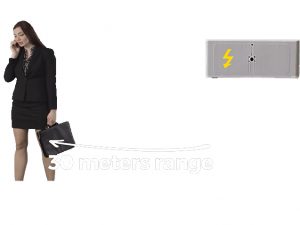
Our tech has been assessed by KU-Leuven, benchmarked by Solar Impulse Foundation with the Efficient Solution Label after being perused technically, economically, and as beneficial to the environment.
Next generation of living wireless 2.0
With technological advances and ubiquitous connectivity enabled by WIFI, Bluetooth, and 5G, the world is shifting to a wireless life.
With the convenience of replacing the wires in several devices and appliances, consumers are now, demanding the same comfort and flexibility, and the spatial freedom experiences they enjoy for charging and/or feeding (direct energy flow to operate), be applied in all devices. Energy should be available everywhere and as convenient as Wi-Fi.
People are already aware of the misfeasance of world resources and the damage to their health by the conventional power transmission technologies used in energy flow and in that context a surging demand for harmless wireless power availability without cable, adapter, touch-pads, and batteries is undeniable.
Alongside our scientific collaboration partner KU Leuven, we are poised to meet the demand for advanced energy and data transfer. Our Magnetic Resonance Technology-Extended (MRT-E) delivers safe, efficient, and intuitive solutions. While presently supporting low-wattage applications, MRT-E is set to extend its capabilities to mid and high-wattage categories, ensuring comprehensive power delivery across various needs.
We try here to explain the technology in plain language as follows:
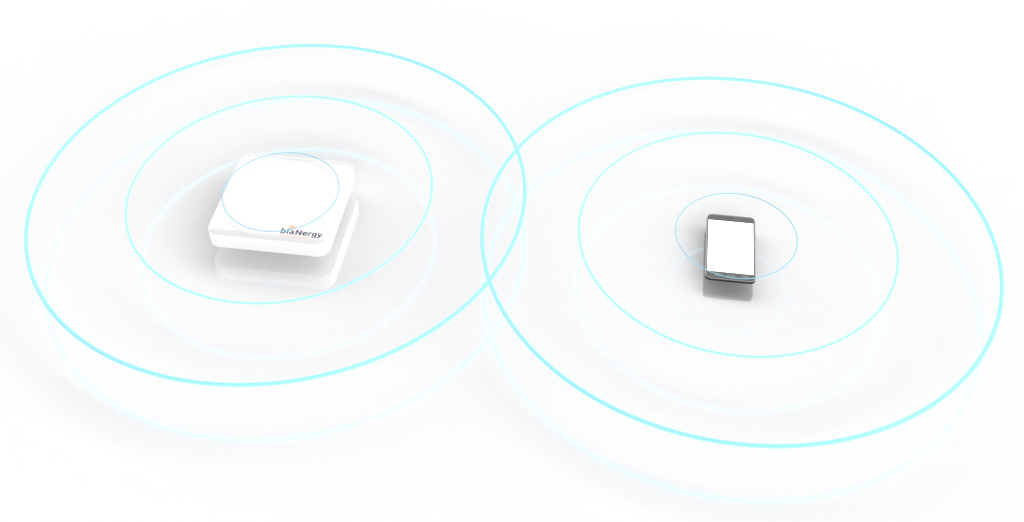
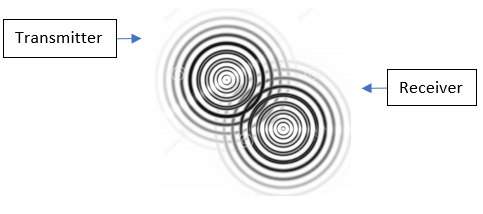
The electricity transfer needs finally a transmitter (which sends the electricity) and a receiver which receives it and lets the device operate where it is embedded or attached to.
The problem ever was and is how to bridge the convenient distance between the transmitter and receiver over the air with
- as much as possible wattage to enable the device to work
- as little as possible loss of energy over the air
- no harm to living beings or objects
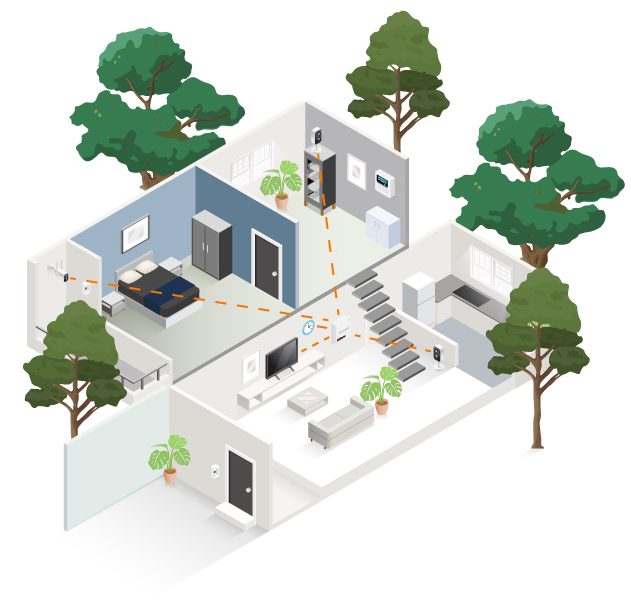
Our system works like Wi-Fi : across levels, non-line-of-site, multi-directional and with an exceptional efficiency quality.
biaNergy solved these 4 problems successfully as a novelty: Distance, Efficiency, Safety and Non-Line-of-Safety (NLOS)
- We can currently transfer in the lower wattage (up to 6 Watts, in the EU 4 Watts), which is good enough to operate all IoT devices, e.g., wristwatches, hearing aids, smartphones, eye-ware, displays, any sensor, and most importantly like AA & AAA batteries acting receivers in the same shape of a battery – up to far distance (MESHable)
- The efficiency quality of our tech is enough to operate the use cases
- We heed the regulation limits that our technology is harmless to all living beings and objects
- Our MRT-E technology is working across levels (transmitting energy & data thru the doors and walls – alike wi-fi, being NLOS.)
Stating that let’s now give an example of which premise is the next to explain our technology.
What is Magnetic Resonance Technology-Extended (MRT-E)?
You know MRT from the health sector, scanning the body. But that is another MRT that we use in the health sector. We employ the electrical energy and change it into an oscillating format. Simplified said as we (even rarely) experience it in the following example:
A resonance is the type in which a singer can shatter a wine glass by singing a single loud, clear, high note. Here, the wine glass is the resonant oscillating system. The sound wave energy is converted to mechanical vibrations of the glass itself. When the singer hits the note that meets the resonant frequency of the glass, on the other side the glass absorbs energy, begins vibrating on the table, and can eventually even shatter. The resonant frequency of the glass is dependent on the size, shape, and thickness of the glass, and how much fluid is in it. The matching of the resonant frequency of both is immediately dependent on the distance as well.
We use here, somehow, the same way trying the energy to transfer, with as little as possible loss, let the resonance of the transmitter and receiver finally meet with the help of RFT implemented as an ushering/bridging proxy to our MRT-E.
Consider these use cases for wireless charging that we can expect soon, enabled by magnetic resonance:
Unaccountable numerous industrial applications would benefit from the removal of wires that pose hazards (for example, electrical wires in a drilling and mining environment are a fire hazard), carry electrical noise (critical to avoid in precision manufacturing), or are otherwise impractical.
One day electric and autonomous vehicles can charge wirelessly by simply driving over a charging pad in the garage or parking lot, eliminating gas stations and making potentially autonomous vehicles even more self-sufficient.
The entire office experience will be more user-friendly and aesthetically pleasing as phones, laptops, mouses, speakers, wearables, and lights can charge and operate throughout the day without a wire in sight and sockets.
By going wireless on-air we correspond with 7 of 17 ESG Goals, concrete examples:
- billions of meters and tons of power cords and metals are not needed to be manufactured anymore and, later, are dumped into landfills.
- batteries with harmful chemicals inside becoming needles
- packaging made of cartons for them is getting superfluous id est saving forests
- devices gaining longer uptime
The next generation of wireless charging
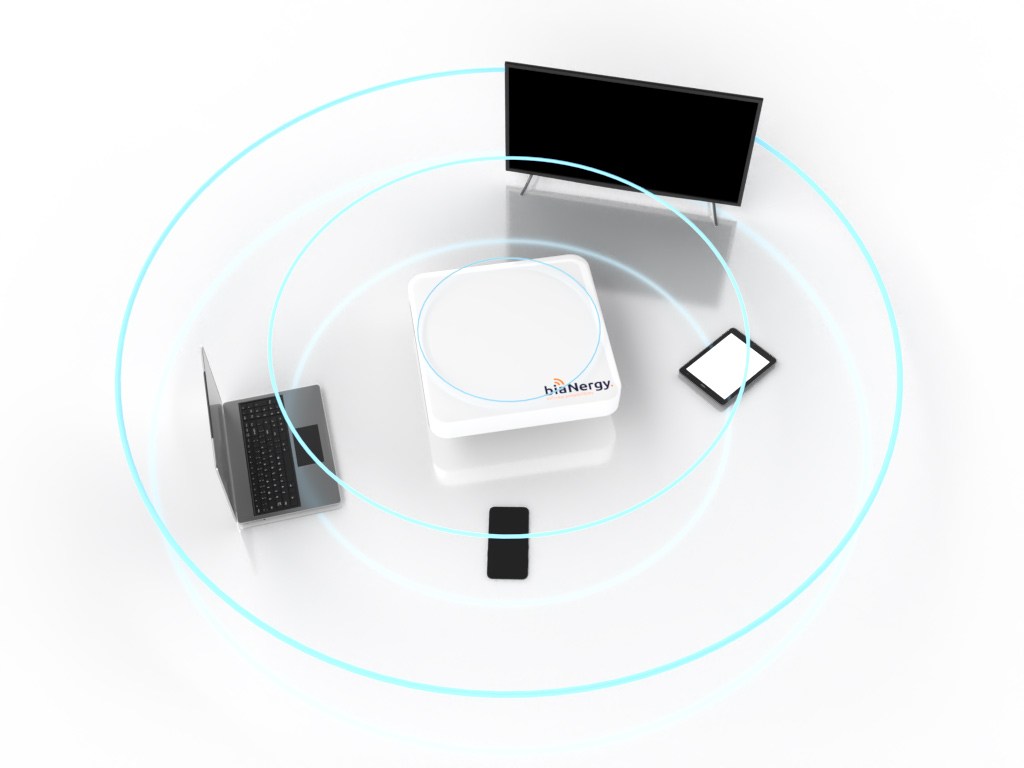
This technology facilitates simultaneous and rapid charging of multiple devices within a three-dimensional spatial volume, providing users with unrestricted device placement. The system employs radio frequency (RF) coupling with Magnetic Resonance Technology – Extended (MRT-E). Target applications include wearable electronics, Internet of Things (IoT) devices, consumer electronics, unmanned aerial vehicles (drones), robotics platforms, and industrial equipment. MRT-E surface-based charging represents a significant advancement over first-generation inductive charging methodologies, offering alignment-free power transfer capabilities for mobile phones, laptop computers, work environments, and similar applications. The biaNergy proprietary Magnetic Resonance Technology – Extended (MRT-E) standard enables simultaneous charging of multiple devices at high rates, independent of precise device positioning on the charging surface.
Safety
Regulatory bodies and governments have set guidelines to ensure wireless charging is safe, and meeting safety regulations is a critical part of bringing the product to market. Planning for regulatory compliance is a core part of the entire product development process. Our technology is approved by FCC and compliant with EU regulations as being harmless to all living beings and objects.
Frequently asked questions
As consumer electronic devices become increasingly prevalent and our need for mobility grows, the safety of wireless power transfer exposure is of paramount importance. To address common concerns, we answer frequently asked questions regarding the safety of wireless power systems below.
The scientific community possesses a strong understanding of how electromagnetic fields interact with the human body, thanks to extensive research. Regional authorities, such as the FCC in the United States, and ETSI in European Union regulate products that emit electromagnetic fields to guarantee adherence to established safety standards. Consumers can be confident that products available for purchase meet or exceed these stringent safety requirements. Products failing to meet these criteria are not permitted for sale.
There are two primary types of electromagnetic radiation: ionizing and non-ionizing radiation. Ionizing radiation is radiation that can directly affect changes in the atomic structure of the body by ionizing atoms. Such radiation includes X-rays, Gamma-rays, and others above the frequencies of visible light (e.g. petahertz to exahertz). Ionizing radiation is mostly used for medical and inspection technologies and requires more stringent regulation for exposure. Non-ionizing electromagnetic radiation is more common and includes wireless radios, WIFI, and other general electromagnetic waves used for communication and power (e.g., kilohertz to gigahertz). Non-ionizing radiation within prescribed limits is safe. Regional regulations ensure that products do not exceed certain levels of emission to prevent interference with other systems and are safe for humans. Non-ionizing radiation typically does not cause any immediately noticeable effect in the body, however, at high intensities could cause tissue heating or nerve stimulation via an induced electric field in the body. SAR, or “specific absorption rate”, is the measure of power (watts) induced in tissue per weight of the tissue (kilograms). An induced electric field is the measure of induced electric potential (volts) caused by electromagnetic radiation across a given distance in the body (meters). Regulations are usually expressed in limits on these quantities.
Electric and magnetic fields are both categories of electromagnetic fields. Whenever a time-varying electric field exists, there is a corresponding magnetic field, and vice-versa which have dominant electric potential are distinguished from those that have dominant magnetic potential. Each of these types of fields has different effects on the body and may behave differently around diverse types of materials. In this sense, it can be important to distinguish between the two types of fields and which is dominant. Wireless power transfer technology such as magnetic induction and magnetic resonance is based on transferring energy using the magnetic field component in the reactive near-field region. These reactive near-fields are non-radiative and fall off with distance at a rate much faster than far-field RF technology like WIFI, cell phones, etc.
Any technology employing electromagnetic energy—like Wi-Fi, Bluetooth, RF—emits radiation. Like all radiating products, cell phones and wireless power systems are regulated and must adhere to safety standards. Cell phones are often referenced due to their mobility and close body contact (e.g., held to the ear/head). The need to communicate with distant base stations, combined with direct head contact, can lead to higher RF exposure from cell phones compared to other devices.
The safety of non-ionizing electromagnetic radiation, commonly referred to as radio frequency (RF) exposure, is overseen by a local regulatory body designated by each country. In the USA, the Federal Communications Commission (FCC) sets these limits, while in the EU, the European Telecommunications Standards Institute (ETSI) establishes the relevant regulations.